Wednesday, May 27, 2015

Ontario Trails - Toronto, it's safer for cyclists to roll through stop signs


It's safer for cyclists to roll through stop signs: Cycle Toronto

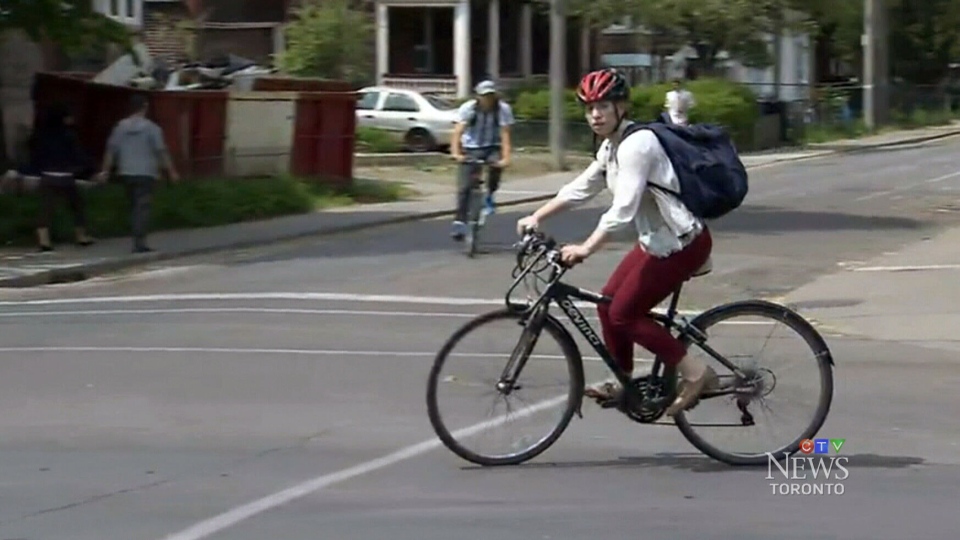
CTV Toronto: Rolling right through stop signs
A group of cycling advocates are seeking to change the rules to allow cyclists to treat stop signs as yield signs.
143
17
160
  • 17

CTV Toronto
Published Monday, May 25, 2015 6:46PM EDT 
A Toronto-based cycling advocacy group is lobbying the Ontario government to change a provincial law to allow bikers to do an "Idaho stop," or a roll stop, on residential streets.
Jared Kolb, the head of Cycle Toronto, says the city should follow in the footsteps of the northwestern U.S. state, where cyclists are allowed to treat stop signs as a yield.
"The rationale behind this is that bicycles are momentum-based vehicles," Kolb told CTV Toronto on Monday. "All the energy, all the work in cycling is in starting and stopping."

PHOTOS

Under Ontario's Highway Traffic Act, cyclists are required to treat three- and four-way stops on low-speed, residential roads as complete stops.
So far, the push to change this law has the support of many local cyclists, who argue a roll stop is safer and may help to lower the rate of bicycle crashes.
"Most people who are responsible cyclists are doing an Idaho stop," Toronto Bicycling Network spokesperson Joey Schwartz said. "In Idaho, when it was first brought in, cycling incident and collisions actually went down 14.2 per cent."
According to a 2003 City of Toronto study, vehicle-cyclist collisions at intersections controlled by stop signs can result in "serious consequences."
The study, which examined more than 2,500 crashes between Jan. 1, 1997 to Dec. 31, 1998, said there were 65 reported collisions during that two-year period where either a driver or cyclist disobeyed traffic rules. Of those crashes, two were fatal. There were 10 cycling fatalities in total during the study period.
In Idaho, cyclists are also not required to wait for the traffic signal to turn green before riding through an intersection. Cyclists must come to a full stop at a red light, however, may pedal through the before the signal changes if it's safe to do so.
Kolb says his group is not pushing for the Ontario government to introduce similar changes to the province's cycling laws. He says they are only looking to loosen the rules.
Meanwhile, law enforcement officials say stop signs are not suggestions, stressing that until the laws change, an "Idaho stop" is not allowed at Ontario stops.
With a report from CTV Toronto's Natalie Johnson

Tuesday, May 26, 2015

Ontario Trails - Headwaters Institute and local partners leading 2 hikes in City of Kawartha Lakes to encourage locals to get active


Headwater hikes take place on the Oak Ridges Moraine this weekend

The Ontario Headwaters Institute and local partners are leading two headwater hikes in The City of Kawartha Lakes this weekend to encourage local residents to get active

Kawartha Lakes This Week
KAWARTHA LAKES - The Ontario Headwaters Institute and local partners are leading two headwater hikes in The City of Kawartha Lakes this weekend to encourage local residents to get active, visit a headwater area, and engage in the co-ordinated review of the province’s Greenbelt Plan and three other land use plans.
The hikes will take place at the Pigeon River Conservation Area on Saturday, May 23 and Fleetwood Creek Natural Area on Sunday, May 24. Participants should arrive by 9:45 a.m. Each hike will highlight a variety of environmental features and is designed to familiarize participants with the importance of the region’s headwaters, including local wetlands, small streams, and their catchment areas.
According to the Institute’s, Andrew McCammon, “Headwaters are the foundation of our watersheds and nurture more biodiversity than any other type of habitat in Ontario”.
Headwaters play a crucial role in protecting the region’s drinking water, reduce flooding and erosion, and contain key habitats for fish, insects and other wildlife.
The hike at Pigeon River Conservation Area is roughly three km over easy ground and will take about 90 minutes.
The second hike at Fleetwood Creek Natural Area is about four km over rough and rolling trails and will take an hour and 45 minutes. Those taking part should wear supportive footwear with a good tread and bring water. Participants can hope to see trilliums, trout lilies, and other plants that find their niches in small forests, wetlands, and along stream banks.
Hike partners include the Friends of the Greenbelt Foundation, Kawartha Conservation, The City of Kawartha Lakes, Save the Oak Ridges Moraine Coalition, and the Ontario Heritage Trust.
Heather Stauble, local councillor and the chair of Kawartha Conservation, will be one of several co-hosts at each hike, where a group of leaders will point out ecological points of interest.
Participants will also be encouraged to provide feedback on the Ontario government’s review of four land use plans by submitting comments on the Province’s Environmental Bill of Rights website or by emailing their comments to landuseplanningreview@ontario.ca. The government is coordinating the review so that each Ontarian can share her or his voice on the Greenbelt—so it remains the solution for clean water, fresh air, healthy local food, and a thriving economy with good jobs.
In addition to this public hike, the Friends of the Greenbelt Foundation, the Institute, and 19 regional partners have collaborated in posting self-guided descriptions for ten hikes spanning the Niagara Escarpment and the Oak Ridges Moraine, and across the nearly two million acres of Greenbelt, from St. Catharines in the south, arching above Hamilton, Oakville, and Toronto, and extending east to the City of Kawartha Lakes.
Further details regarding the locations can be found at http://ontarioheadwaters.ca/hikes.

Monday, May 25, 2015

Ontario Trails - Council seeks timeline for K&P Trail Completion, Kingston


By Elliot Ferguson, Kingston Whig-Standard
Kingston city staff are to look for ways to connect the rural portion of the K&P Trail to the city centre. (Elliot Ferguson/The Whig-Standard)
The city could be racing the clock to complete the long-awaited urban portion of the K&P Trail.
Council directed staff on Tuesday night to start work on plans to complete the urban portion of the trail in time for Canada’s 150th anniversary in 2017.
“The question isn’t really if we want to do this, but when,” Sydenham District Coun. Peter Stroud, who put forward the motion, said.
Finishing the urban portion of the trail would connect Kingston to the Cataraqui Trail, which is part of the national Trans Canada Trail.
Finishing the K&P in Kingston has been on city council’s to-do list for about a decade and it was again included among the strategic priorities for the current council earlier this spring.
Stroud said the motion only creates a timeline for a project that is already on the list of future plans.
The nation’s sesquicentennial provides the motivation to finally finish the urban portion of the trail.
“We don’t have a choice on the date,” Stroud said.
Countryside District Coun. Richard Allen said the trail could provide a valuable link between the city’s rural and urban areas.
But Allen said he was concerned about the potential costs.
He also noted that the Waterfront Trail, which connects communities around Lake Ontario, runs through the heart of Kingston.
In the Kingston area, with the exception of a short section through Lake Ontario Park, the Waterfront Trail consists largely of bike lanes on roadways.
The K&P Trail, being a former railway, is entirely separate from roads except for intersections.
“The Trans Canada Trail is some distance from the heart of Kingston,” he said.
Allen’s concerns about cost were reinforced by a caution from Community Services Commissioner Lanie Hurdle.
Hurdle said city staff would look at different options to complete the trail, but she said the work could be expensive.
“I need to stress, the cost estimates are not going to be $200,000, $400,000,” she said. “We are talking about millions of dollars.”
Mayor Bryan Paterson was also concerned about council adopting motions that call for action on specific priorities, since there are more than 40 such items in six broad caterories.
What makes this project stand out from the others is the timing, Paterson said.
The K&P Trail was built on the rail bed of the former Kingston and Pembroke Railway, a post-Confederation project that, according to the original plan, would service the burgeoning mining, lumber and agricultural economies of eastern Ontario as it snaked its way from the shores of Lake Ontario to the Ottawa River.
The railway was never built all the way to Pembroke, and as timber and mining declined, the line was leased to the Canadian Pacific Railway for 999 years starting in 1912.
Today there are six access points in the 15-km multi-use trail in the semi-rural and rural part of Kingston between Little Cataraqui Creek and Orser Road.
Beyond the confines of Kingston, the K&P Trail runs 31 km from Orser Road to White Lake Road.
The trail has become a key to the tourism strategies of Frontenac County and its member townships.
Frontenac County is celebrating its sesquicentennial in 2015.
County council was briefed on the trail’s development at Wednesday morning’s council meeting. Its development has been supported by funding from the Frontenac Community Futures Development Corporation for bridge engineering and building, the Eastern Ontario Trails Alliance and the Trans Canada Trail trail development grants.

Friday, May 22, 2015

Ontario Trails - Island Cycling Advocates remain a serious player in cycling world


Island Cycling Advocates remain a serious player in the cycling world

by  - 
The 2015 Manitoulin Island Cycling Advocates executive is, from left, Guy Nielen, Maja Mielonen, Peter Ford, Pam Jackson and Mathew Redmond. Missing from photo is Joshua Shaw.
by Betty Bardswich
SPRING BAY—The Manitoulin Island Cycling Advocates (MICA) held their annual general meeting on May 11, complete with two guest speakers and an election of board members.
Board chair Maja Mielonen welcomed members and guests and, after approval of the 2013 minutes, invited Pam Jackson, treasurer, to make her report. Ms. Jackson stated that the organization was in good financial shape and it was noted that registration fees for the Manitoulin Passage Ride had doubled from 2013 to 2014. This event for 2015 is sold out with 224 cyclists slated for the June 6 and 7 ride.
Ms. Mielonen then spoke of the history of MICA, which started in 2010, saying that the Island is now known as the best cycling destination in Northern Ontario. She talked of the great success that was previously obtained with the paving of shoulders on Highway 6 and noted that the bicycle paths for the road between Mindemoya and M’Chigeeng will be paved this summer. She also made mention of the many benefits for Manitoulin with the Passage Ride as businesses gain from this event in the off season of early June. Ms. Mielonen also noted that there is a network of over 12 routes on Manitoulin for cyclists and the organization has had great success in selling over 6,000 copies of their maps which are sold all over the Island and on the ferry. “This is ongoing,” Ms. Mielonen stated, “and really has changed the face of the Island and lots of new riders are coming on.”
Ms. Mielonen also talked of the Georgian Bay Cycle Route with over 1,000 kilometres for cycling. She spoke of the provincial funding announcement for CycleON that was made on April 1 to the sum of $25 million in cycling infrastructure. There is also $10 million slated for the Ontario Municipal Cycling Infrastructure to help municipalities expand their local cycling routes, connect with provincial routes and launch pilot projects to make cycling improvements. As Ms. Mielonen noted, MICA will tap into the municipal cycling plan.
MICA has been incorporated since the first of March and has also partnered with 4elements, an Island non profit arts organization started in 2002 and incorporated in 2009. Ms. Mielonen is a member of that organization’s board and the two groups will work together and promote each other. 4elements executive director Sophie Edwards was on hand at the MICA meeting to speak of initiatives of the organization, including the bike ride on Canada Day last year in Little Current, training workshops, get active with arts projects and land art at Providence Bay beach. Ms. Edwards announced funding from The Ontario Arts council to create the design for permanent sculpture on cycle trails. A trail sculpture project now in progress is with 17 students at Central Manitoulin Public School. The initial project was to design a sculpture using only wire and wood shims and to then cycle with Ms. Mielonen and Guy Nielen to the area where the finished sculpture will be. As Ms. Edwards noted, the impact of this project is to learn about cycling safety, bike routes and engage in participatory art making with the potential to have permanent sculptures that are site specific and created by local and visiting artists such as Michael Belmore, Bonnie Devine, Ann Marie Hadcock and community members.
Ms. Mielonen then spoke of the magazine This is Manitoulin which has a double page for cycling and was handed out by herself and Mr. Nielen at the Bike Show in Toronto. A survey done shows that 94 percent of people cycle while on vacation, 93 percent consider cycling when choosing a destination, 100 percent stop at points of interest with 93 percent being influenced by these points. As most cyclists start at a trailhead and follow signed route suggestions, MICA will now embark on a mission to convince the Ministry of Transportation (MTO) to allow signage highlighting restaurants, sculptures and nature trails on provincial highways. A petition to begin with a pilot project for the way signs has started and will be available for signatures at the Manitoulin Trade Fair and Maja’s in Mindemoya.
The second guest speaker at the MICA meeting was Rick McCutcheon, publisher of The Expositor, who asked the members to use the creds that they have developed in other areas. “Your organization has impressed many,” Mr. McCutcheon, “and your association with 4e is great. You have gone from strength to strength in a short time. MICA is a serious player in the cycling world.”
Mr. McCutcheon also stressed the importance of MICA members and everyone to support the ferry and threw out the challenge for using MICA’s well-earned way of getting things done to support the ferry.
Ms. Mielonen agreed with Mr. McCutcheon, saying “it takes all of us to make an impact.”
MICA member Gary Fuhrman spoke of the 5th Annual Passage Ride, saying that a total number of 224 riders were registered with 201 people coming to Manitoulin with 156 of those taking the ferry, and 28 coming for the one-day ride with nine arriving by Chi-Cheemaun. The riders are coming from Michigan, Ohio, Ottawa, Toronto, Guelph and Caledonia area, Barrie Innisfil, Missauga and Oakville with 45 riders from Sudbury, North Bay. Espanola and Manitoulin.
It was also announced at the meeting that Lightfoot Bikes has moved from north of Mindemoya to Manitowaning on Highway 6 with Joshua Shaw being the new owner.
The final item on the MICA agenda was the election of board members with five positions open. Elected were Maja Mielonen, Peter Ford, Pam Jackson, Mathew Redmond and Joshua Shaw who will join board member Guy Nielen. It was noted that the board will elect directors.
- See more at: http://www.manitoulin.ca/2015/05/20/island-cycling-advocates-remain-a-serious-player-in-the-cycling-world/#sthash.Mp6cSfxR.dpuf

Thursday, May 21, 2015

Ontario Trails - Concern about G2G Rail Trail 2015


By Dave Flaherty, Goderich Signal-Star
Although most county councillors are in favour of the Goderich to Guelph Rail Trail (G2G), some members are questioning how everything came together.

Paul Vander Molen, Huron County representative on the G2G steering committee and Chris Lee, vice-chair of Goderich to Guelph Rail Trail Inc., provided an update to council at the May 13 committee of the whole meeting.
North Huron Mayor Neil Vincent said while he supports the idea of the trail, he has some concerns.
Namely, he said North Huron already has a lease on part of the trail.
“What assurances can you give us on the liability,” he asked.
Vincent also believes the consultation process has not been as transparent as G2G Rail Trail Inc. has indicated.
“It has been a closed process so far,” Vincent said.
In his view, the concerns of adjacent landowners have not been addressed sufficiently.
“Adjacent landowners can make or break a trail,” he said. “Don’t tick off the neighbours.”
He also urged Lee and Vander Molen to make sure they have support from stewardship groups “on paper”, citing a similar situation in North Perth where the municipality now has to have a full-time employee to maintain a trail.
Central Huron Mayor Jim Ginn said a recent press release from the G2G “caused problems” in his municipality.
He also believes landowner issues have not been addressed and the press release made it appear some local politicians have “gone back on their word”.
Ginn then requested a copy of the interim lease be provided to county council.
Vander Molen defended the actions of the group so far, saying they’ve been very transparent and worked closely with a group of county staff.
However, he said it was not their intention to “circumvent county council” and they are willing to listen.
“We are concerned about the concerns of adjacent landowners,” he said.
Bluewater Mayor Tyler Hessel spoke highly of the trail and the work of G2G Rail Trail Inc. so far.
“I think we should commend a group that works towards active transportation and healthy lifestyles,” he said.
Hessel said the G2G was a perfect example of “not worrying about borders” and regional partnerships.
“This is a game changer. It will be bring new people in our communities,” he added.
Moving forward, Vander Molen said there are some issues that need to be addressed.
“Our biggest concern is ATVs,” he said. “As far as landowners are concerned, we are stopping the ATVs until clubs can convince the Ontario government (to allow them on the trail).
Another concern is milkweed, which some stewardship groups would like to see planted along the trail to attract Monarch butterflies.
However, because of the potential dangers of milkweed to humans, Vander Molen said the plant must be managed carefully.
“That’s why it is important for the county to be involved,” he said.
The lease between the Ontario government and G2G Rail Trail Inc. will commence on July 1.
“It’s exciting to see some concrete action,” Lee said. “Our vision has always been to move to the point where users have a seamless experience.”
Lee said the newly introduced Ontario Trails Act will “break down all barriers to trail development.”
Vander Molen admitted they were “surprised as anyone” when the government approved the lease and told them they would be moving forward on July 1.
Once completely open, the trail will span 127 km from Goderich to Guelph.
Local municipal councils can expect visits from G2G representatives in the near future, Vander Molen added.
The goal is for the municipalities which the trail runs through, including Huron County, to take over the lease.

Wednesday, May 20, 2015

Ontario Trails - Clearwater residents to cycle for global warming petition


Clearwater residents to cycle for global warming petition

Times editor Keith McNeill gets ready for a training ride with longtime North Thompson resident Jean Nelson recently. The pair plan to cycle from Toronto to Ottawa soon to promote a petition on global warming. Nelson was Mrs. Chatelaine in 1970 and the former chair of School District 26 (North Thompson).      - Yevonne Cline
Times editor Keith McNeill gets ready for a training ride with longtime North Thompson resident Jean Nelson recently. The pair plan to cycle from Toronto to Ottawa soon to promote a petition on global warming. Nelson was Mrs. Chatelaine in 1970 and the former chair of School District 26 (North Thompson). 
— Image Credit: Yevonne Cline
Can your editor keep up with Jean Nelson on a bicycle?
That's the central question to be answered when Nelson and I cycle from Toronto to Ottawa May 23 – June 2.
Mind you, anyone who knows Jean and who knows me already knows the answer.
Jean might be an 80-year-old grandmother, but she's also remarkably fit.
She has competed in cycling at the BC Seniors Games for many years and consistently wins medals (although not all gold, as she modestly says). She also has completed several lengthy bike tours in places such as Iceland.
Your editor, on the other hand, spends way too much time behind a computer and in the office.
I haven't done much cycling for many years and I have never done a long bike trip.
Of course, there's also the question of promoting a global warming petition that your editor has posted online at Care2.
The petition calls for a Canada-wide referendum on carbon fee-and-dividend.
So far it has collected more than 28,000 names - not too bad, but far from the 400,000 target.
Carbon fee- and-dividend, for those interested, is a proposed method to control human-caused global warming.
A fee would be charged on fossil fuels at the wellhead, mine or point of import - similar to a carbon tax.
Unlike a tax, however, the money collected would not go into general government revenues. Instead, it would be distributed in equal and repeating dividends to everyone.
As stated on the petition, a Canada-wide fossil fuel fee set at the same level as B.C.'s carbon tax ($30 per tonne of carbon dioxide produced) would generate about $20 billion per year.
Assuming there are about 20 million adults in Canada, that would mean each person over age 18 would receive carbon dividends totalling close to $1,000 per year.
(The actual numbers, for the sticklers in the crowd, are $21 billion in fees, 24 million adults, and $875 in dividends annually).
We know carbon taxes work in reducing  carbon dioxide production. A fossil fuel fee should work as well or better.
The carbon dividend would be an important step in reducing the economic inequality that is increasing in this country.
Those getting the lowest 10 per cent of income would collect 150 per cent more in carbon dividends than they would pay in fossil fuel fees.
In fact, two-thirds of Canadians would collect more or at least break even.
Those who would pay the most would be people with a lot of shares in fossil fuel companies and/or whose lifestyles include multiple homes, yachts and private jets.
"Why ask for a referendum?" is a question sometimes asked.
In my opinion, this question is altogether too important to be left to the politicians.
In Switzerland, the citizens have the right, through a petition with 100,000 signatures, to bring forward any important question to a national referendum – meaning the people get to vote on it.
Canada has about four times the population of Switzerland and so the online petition calls for 400,000 names.
We don't really expect to get that number and, even if we did, it would not be legally binding.
Still, it's a worthwhile goal and it does get the idea out there that we need more democracy, not less, if we are to solve the problems that face us.
Jean and I plan to start our trip from the Rouge Hill GO station northeast of Toronto on Saturday, May 23 (at 10 a.m., if you have any friends or relatives there who might want to see us off).
That day will see a relatively short ride to Oshawa.
May 24 - about 60 km to Coburg.
May 25 – Trenton.
May 26 – Napanee.
May 27 – Kingston.
May 28 – spend a day Kingston.
May 29 –  Rideau Lakes, stay at historic Hotel Kenney.
May 30 – Smith Falls.
May 31 – Carleton Place.
June 1 – Ottawa.
At noon on June 2 we will meet Citizens Climate Lobby – Canada national manager Cathy Orlando at the Centennial Flame in front of the Parliament Buildings.
There we will give her six memory sticks containing the names on the petition as of that date.
Orlando then will pass them on to the leaders of the six parties in the House of Commons: Conservative, New Democrat, Liberal, Green, Bloc Quebecois and Force et Democratie.
If you want to add your name to the petition, the URL iswww.thepetitionsite.com/850/161/365/petition-for-a-referendum-on-carbon-fee-and-dividend-for-canada/ (or Google: Care2, petition, carbon fee, Canada).
Please get others to sign as well.
We may not save the world, but at least we intend to have fun trying.
Below: A cartoon by Clearwater resident Max Roy gives an opinion of a bike ride that Times editor Keith McNeill plans to make from Toronto to Ottawa May 23 - June 2. While in Toronto McNeill plans to pick up an award the newspaper won for first place in best editorial page from Canadian Community Newspapers Association.
Bike Cartoon

Tuesday, May 19, 2015

Ontario Trails - Government Expands Ontario Trail Network


Web posted on May 19, 2015
Ontario will introduce new legislation today to protect and improve thousands of kilometres of the province's urban, suburban, rural and remote land and water trails network while encouraging its expansion.
The province has approximately 2,500 trails and more than 80,000 kilometres of trail; the second-largest network in Canada. This includes almost 20,000 kilometres of trails are located within municipalities. Thousands of kilometres of trails and roads are on provincial Crown land that are open for the public to use free of charge.
If passed, the Supporting Ontario's Trails Act would:
  • Provide the trails community with enhanced tools to effectively develop, operate and promote trails

  • Remove barriers to help connect and expand trails across the province

  • Increase trail awareness and promote local tourism by enabling the recognition of trails of distinction, supporting communities and jobs across Ontario

  • Enable the development of a classification system to help users find trails that match their interest and ability
"We are delighted to continue working alongside the Ontario government towards expanding the Trans Canada Trail across the province, and to improving the lives and communities of Ontarians. Our partnership with the Government of Ontario is vital to Trans Canada Trail achieving our Canada-wide connection goal by 2017, Canada's 150th anniversary of Confederation." Paul LaBarge, Chair of Trans Canada Trail.
The proposed act would also improve, sustain and encourage the expansion of trails by addressing liability, trespassing and crown land issues. Since 2009, Ontario has invested more than $80 million in trails. Ontario will complete 250 kilometres of gaps in Ontario's Trans Canada Trail and connect communities from Ottawa to Windsor and Fort Erie to Huntsville.
"Each year, millions of Ontarians and visitors from outside the province experience the province's world class trail system. Our trails encourage explorers of all ages and abilities to visit our unique communities and support local economies and jobs. To ensure this continues and our trails remain vital for future generations, Ontario will introduce new legislation today that would, if passed, contribute to an improved, safer and more sustainable trails network." Michael Coteau, Minister of Tourism, Culture and Sport.
Expanding and improving Ontario trails is part of the government's plan to build Ontario up. The four-part plan includes investing in people's talents and skills, making the largest investment in public infrastructure in Ontario's history, creating a dynamic, innovative environment where business thrives and building a secure retirement savings plan.

Monday, May 18, 2015

Ontario Trails - Cheltenham Badlands northwest Toronto close to halt tourist damage


Ontario's Cheltenham Badlands to close to halt tourist damage

The Cheltenham Badlands
The Cheltenham Badlands, located northwest of Toronto, are shown in a handout photo. (Handout / Ontario Heritage Trust)

The Canadian Press
Published Wednesday, May 6, 2015 5:24PM EDT 
CALEDON, Ont. -- The Cheltenham Badlands northwest of Toronto will be closed to visitors likely for several years starting at the end of this month while a long-term conservation plan for the ecologically sensitive site is developed, says the Ontario Heritage Trust.
The seven-hectare landscape of hummocks and gullies -- considered one of the best examples of badland topography in Ontario -- draws thousands of visitors annually, a number that has risen in recent years, said Catrina Colme, spokesperson for the trust, which owns the site.
"The increasing number of visitors has been causing accelerating erosion, and the closure is a protective measure to stop further damage," Colme said.

The large number of visitors' cars parked on the shoulder of Olde Baseline Road, which skirts the badlands, has also raised safety concerns, she said.
Over the years numerous signs asking people to stay off the badlands have been vandalized or removed, Colme said.
"Safety along that road is another big factor, so closing off access will hopefully discourage people from stopping."
A fence will be erected along the road to keep people off the badlands, an hour's drive from downtown Toronto.
An environmental consultant will begin work on the conservation plan this summer.
Removal of vegetation during land clearing and livestock grazing in the early 1900s led to erosion of the red shale bedrock, producing the badlands' distinctive appearance.