Friday, May 29, 2015

Ontario Trails - Students hired by Path of the Paddle, canoeing from Thunder Bay to Whiteshell.


U of W students hired to report on Trans Canada Trail paddle

  •  
Paul Schram and Hadley Burns have been hired by Path of the Paddle to spend 10 weeks canoeing from Thunder Bay, Ont., to Jessica Lake in the Whiteshell, sharing their experiences along the way.
Paul Schram and Hadley Burns might want to pack a horseshoe and rabbit's foot along with their freeze-dried pineapple and tent to prolong their good luck.
The University of Winnipeg education students landed a summer job most outdoorsy people could only dream about -- paddling a canoe from Thunder Bay, Ont., to Jessica Lake in Whiteshell Provincial Park in 10 weeks.
The pair have been hired by Path of the Paddle as trail ambassadors for the canoe-based section of the Trans Canada Trail, which is about 1,000 kilometres long. They plan to launch their canoe in Thunder Bay June 18.
Path of the Paddle is an Ontario-based organization that promotes canoe and kayak routes in northwestern Ontario.
"Our job is to paddle this trail throughout the course of the summer and promote it," Schram said Tuesday. "It's not as remote as what we've done in the past. It's a lot more accessible. But there are a lot of portages. I think we have between 200 and 300 portages on this trip."
Schram, 23, and Burns, 24, are graduates of the YMCA-YWCA's Camp Stephens Wilderness Program. Last summer, each led six-week canoe trips for young men and women.
The route they're paddling is fairly well-established, with campsites and portage routes, compared with canoe trips they've taken on more remote rivers in northern Manitoba and Saskatchewan.
It's the national canoe route of Canada's Trans Canada Trail and there is no land-based trail to hike. It has been dedicated to Canada's First Nations and canoeing icon Bill Mason, and covers 1,000 kilometres starting at Thunder Bay. It follows the Pigeon River and the Gunflint Route to Quetico Wilderness Park and then Atikokan. It then follows the Turtle River waterway system to Dryden through to Kenora, Ont., and finishes along the Winnipeg River system at Jessica Lake.
They're starting the voyage with 30 days worth of food packed, with planned food pickups in Atikokan, Dryden and Kenora.
Burns said they will use a lightweight Souris River canoe for the trip.
"It sounds kind of intimidating, but when we go to pack it really won't be that much," Burns said. "We're just packing for two."
She said they're experimenting with the menu.
"We've been dehydrating tons of food for the past week," she said. "We've dehydrated tons of pineapple. Another thing we've been able to purchase is a ton of protein bars. We're also taking a lot of protein powder just to supplement being out that long."
Burns said they will be able to take time to explore their surroundings, such as searching out indigenous rock paintings.
"Part of it will be taking the time to appreciate what's around us," she said.
"It will be a new experience for me compared to past trips from Camp Stephens," Schram said. "It's a neat opportunity to see a lot of areas we haven't paddled before. We'll be running into a lot of people along the way, and I think sharing stories and getting to know people out there is something we haven't experienced as much, and something we're both looking forward to."
Schram and Burns will share what they are seeing and experiencing along the way. They will use Spot Connect to obtain satellite service for their smartphones so they can update Facebook, Twitter and Instagram on their progress. They'll also take photographs and shoot video.
Fore more information on the trip, visit: pathofthepaddleassociation.com.
bruce.owen@freepress.mb.ca
Republished from the Winnipeg Free Press print edition May 26, 2015 A6

Thursday, May 28, 2015

Ontario Trails - Wheels Turning on good cause, Lake Ontario


By Michael Lea, Kingston Whig-Standard
Riders taking part in the annual Seven Days in May cycle ride around Lake Ontario to raise money for pancreatic cancer research leave the Cancer Research Institute in Kingston for the next leg of their 1,100 kilometre journey. (Michael Lea/The Whig-Standard)
Cycling around Lake Ontario wasn’t in Martin Sowden’s plans for this spring.
But, then, getting pancreatic cancer wasn’t in his brother-in-law’s plans, either.
Richard Smith of Vancouver was planning his 65th birthday and set to retire after 39 years with CN when he started getting back pains just before Christmas.
“He didn’t think anything of it,” Sowden said.
But visiting a chiropractor didn’t help, and the pain just wouldn’t go away, so he got it checked out.
A cancerous mass was found on his pancreas. An ultrasound then found it had spread to his liver and lungs.
He was given weeks to live.
There was little Sowden could do to help his brother-in-law anymore, but he could raise money to help pay for more research for pancreatic cancer, a form of cancer with a notoriously low survival rate.
So he joined about 20 other cyclists who are in the middle of a fundraising trip around Lake Ontario.
They stopped in Kingston Monday morning for a brief visit at the Cancer Research Institute on Stuart Street, where they received a standing ovation from staff.
His participation in the ride is in honour of his brother-in-law, Sowden said, who is from the Welland area.
“My wife went searching on the Net for information about pancreatic cancer and in the process found this ride and told me about it. I am a pretty avid cyclist, so I thought I would give it a go.”
He has never cycled for so far or for so long before.
“It’s no easy feat, I’ll tell you that.”
But thoughts of his brother-in-law are with him most of the way and keep him going, he said.
Gord Townley also has thoughts of a loved one that are accompanying him on the ride.
The Mississauga man lost his mother Lorraine to pancreatic cancer back in November 2011.
To honour her and to help raise money to combat the cancer that took her, he and his family started up Seven Days in May, a round-the-lake ride of 1,100 km.
Now a charitable foundation, it has been a family affair from the beginning. His brother-in-law came up with the initial idea, his wife and sister handle the logistics and anyone who wants to can join in.
The first year they had five cyclists, all family and all still taking part.
The next year there were eight, then 14. This year there are 19.
Townley, who runs a small consulting business, doesn’t mind what their reasons are for joining in.
“Some people joined it for the adventure of riding around the lake. Some people joined it because they are inspired by the cause.”
He estimated 75% of this year’s cyclists have been personally affected by pancreatic cancer and are riding in honour of somebody close.
“We ride with inspiration every day,” he said. “I can promise you, today my mother will be forefront in my thoughts.”
The ride is starting to get noticed by the cycling community, and Townley is hoping next year’s will be ever bigger.
He has made a personal commitment to do it for 10 years.
“As long as I can ride, I intend to do this every year.”
Whenever Townley cycles through miserable, cold days on the ride around the lake, he thinks back to a similar day when his mother was near death.
“It was a terrible, wet, windy day and I was angry. I got on my bike and I rode and it was a terrible ride and it worked for me and I felt really good,” he said.
“Every time I am out in one of those nasty days, it just reminds me of that day. It goes through my head and gives me strength.”
This is the fourth year for the ride and the third year it has raised funds for the local Cancer Research Institute.
The money is going to fund a specific pancreatic cancer trial, called PA6.
Dr. Chris O’Callaghan, a senior investigator for the PA6 trial, explained it involves looking at whether a new combination of chemotherapy drugs will provide a significantly longer survival rate following surgery than with the standard chemotherapy drug now in use.
Canada is partnering with France in the trial, and it is running out of 20 centres in seven provinces in this country, an increase over previous years. Fifty-eight Canadians are taking part, double last year’s number.
“The trial is doing well and we are making a substantive contribution,” O’Callaghan said.
It will continue until November 2016.
“This is a trial that matters. This is a trial that has the possibility of improving the rate of cure of pancreas cancer.”
Dr. Jim Biagi, a co-chair of the PA6 trial, said he was impressed by the dedication of the riders.
Many people are touched by cancer, but he found it “so inspiring” that they took it to another level and did something substantial about it.
Dr. Biagi said pancreatic cancer can be a difficult cancer to treat.
“It’s a cancer that, when it is diagnosed, it is already quite advanced.”
Plus, the research funding is lower than for other forms of the disease.
And it is a stubborn cancer, he said.
“We haven’t found very many effective treatments compared to, say, breast cancer or colon cancer.”
But Biagi is hoping trials such as PA6 will result in changes for the better.
Research is “starting to take off” in the last few years, the disease is getting more attention and they are hoping to make earlier diagnoses.
“And we are finding treatments that are actually starting to work.”
Although it is too soon in the trial to make any conclusions, he is hoping the new combination of chemotherapy drugs, call folfirinox, will be more effective than the gemcitabine that traditionally follows the surgery to remove the tumour.
“We are expecting and hoping that folfirinox improves the cure rate,” Biagi said.
After the trial closes in 18 months, it will take another six months to a year before the data can be fully analyzed, he said.
Dr. Janet Dancey, director of the clinical trials group at the centre, said the National Cancer Institute of Canada has been carrying out clinical trials for more than three decades.
“This year is our 35th year of doing trials that matter, trials that can impact patients’ lives, improve outcomes, that can improve quality of life, including those with pancreatic cancer.”
Dancey paid tribute to Lorraine Townley, “who suffered from this disease but did not let it control her life.”
“She was an advocate, she supported patients with pancreatic cancer and she supported research so patients with this disease would have better outcomes than she herself had.”
Deirdre Brough, associate director for corporate engagement with the national office of the Canadian Cancer Society, said the ride was “such an unbelievable endeavour” and had raised more than $72,500 in the past three years. This year’s total was already more than $45,000, “which makes a significant difference in terms of funding such an important trial.”
Brough recognized pancreatic cancer is one of the hardest forms of cancer to treat successfully.
“We know there needs to be more focus on pancreatic cancer and research.”
She said funding for such research continues to rise and will be close to $4 million next year.
Brough also hoped the five-year survival rate for pancreatic cancer, currently at 8%, will also rise, thanks to the work being done through trials such as PA6.
More information on the ride is available online at 7daysinmay.com/donate/the-foundation.

Wednesday, May 27, 2015

Ontario Trails - Toronto, it's safer for cyclists to roll through stop signs


It's safer for cyclists to roll through stop signs: Cycle Toronto

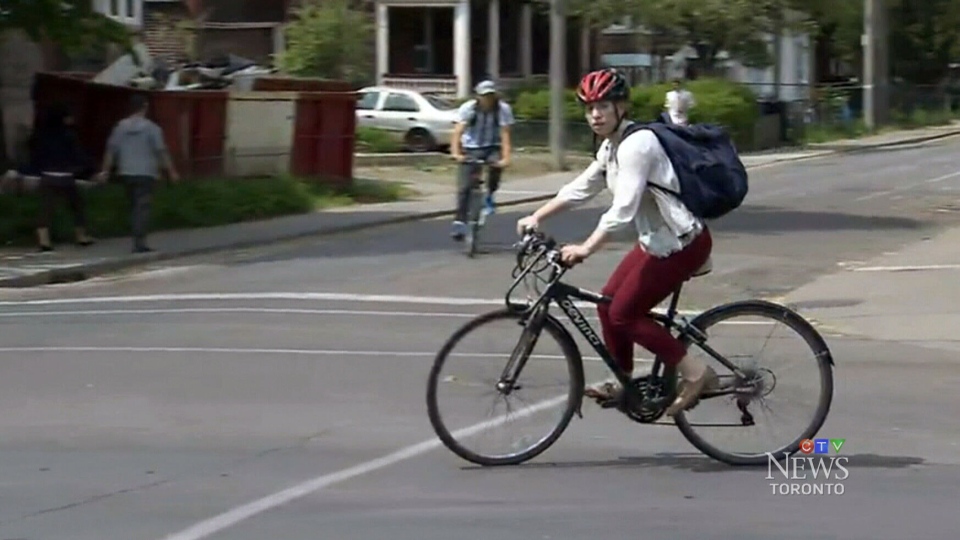
CTV Toronto: Rolling right through stop signs
A group of cycling advocates are seeking to change the rules to allow cyclists to treat stop signs as yield signs.
143
17
160
  • 17

CTV Toronto
Published Monday, May 25, 2015 6:46PM EDT 
A Toronto-based cycling advocacy group is lobbying the Ontario government to change a provincial law to allow bikers to do an "Idaho stop," or a roll stop, on residential streets.
Jared Kolb, the head of Cycle Toronto, says the city should follow in the footsteps of the northwestern U.S. state, where cyclists are allowed to treat stop signs as a yield.
"The rationale behind this is that bicycles are momentum-based vehicles," Kolb told CTV Toronto on Monday. "All the energy, all the work in cycling is in starting and stopping."

PHOTOS

Under Ontario's Highway Traffic Act, cyclists are required to treat three- and four-way stops on low-speed, residential roads as complete stops.
So far, the push to change this law has the support of many local cyclists, who argue a roll stop is safer and may help to lower the rate of bicycle crashes.
"Most people who are responsible cyclists are doing an Idaho stop," Toronto Bicycling Network spokesperson Joey Schwartz said. "In Idaho, when it was first brought in, cycling incident and collisions actually went down 14.2 per cent."
According to a 2003 City of Toronto study, vehicle-cyclist collisions at intersections controlled by stop signs can result in "serious consequences."
The study, which examined more than 2,500 crashes between Jan. 1, 1997 to Dec. 31, 1998, said there were 65 reported collisions during that two-year period where either a driver or cyclist disobeyed traffic rules. Of those crashes, two were fatal. There were 10 cycling fatalities in total during the study period.
In Idaho, cyclists are also not required to wait for the traffic signal to turn green before riding through an intersection. Cyclists must come to a full stop at a red light, however, may pedal through the before the signal changes if it's safe to do so.
Kolb says his group is not pushing for the Ontario government to introduce similar changes to the province's cycling laws. He says they are only looking to loosen the rules.
Meanwhile, law enforcement officials say stop signs are not suggestions, stressing that until the laws change, an "Idaho stop" is not allowed at Ontario stops.
With a report from CTV Toronto's Natalie Johnson