
 |
Find and use your favorite today!User Group Meeting Leads to Survey on Use IssuesThrough various process the Ontario Trails Council has an idea of the number of trail projects and the value that they represent to capital investment in Ontario each year. We also get called regularly to set up processes or advise on how to approach authorities in order to get trail access. In many cases we also write grants and work with groups to stimulate process to get trails developed or built.  What is not so clear is a map of where access and use is at a crossroads. It is clear through sdome discussion that a clearer inventory of hot spots or at risk trails would enable use to better respond to bring change or adjustment so that trails are not lost. We need you to help us by answering our survey on land access issues. We have designed this for both the land manager and the trail user to complete. An e-mail will be sent to OTC Members to complete the survey once it is live. Thanks Credit Valley Conservation Completes Trail - with OTC and National Trails Coalition support.Friends of Island Lake mark successful end to Close the Gap campaign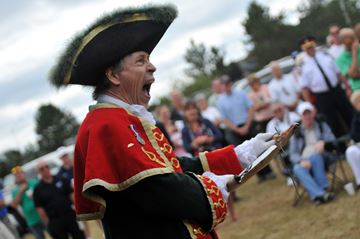 Gap closedChris Halliday
Orangeville Banner
The chair of Credit Valley Conservation (CVC) doesn’t think a project such as the trail system and boardwalks at Island Lake would have been built in larger metropolis areas.
At least not in the hands-on fashion the Friends of Island Lake (FOIL) and their partners did it here in Dufferin County, according to Mississauga Coun. Nando Iannicca. “The people that came out here and rolled up their sleeves, the sweat equity they put in, it is a vocation, it is an honour,” Iannicca said during the celebration marking FOIL’s completion of the 11.5 km Vicki Barron Lakeside Trail around Island Lake on Friday (Aug. 28). “You wouldn’t have had this done in some other bigger cities,” the CVC chair added. “It is quite an achievement and it speaks more to the character and the class of the community above and beyond what was actually built.” More than a decade, $2 million in donations, 11.5 km of trail and 12,000 volunteer hours later, FOIL has finally closed the gap. The final leg of the trail at Island Lake was officially opened for public use in July. On Friday, FOIL past chairman Bob Shirley thanked the dozens of people and organizations that came together to contribute to the planning and construction of the Vicki Barron Lakeside Trail. They were the ones who spent more than 12,000 volunteers hours on the project, whether that meant collecting scrap metal, clearing the trail’s path or screwing wooden planks onto the boardwalk on their own. “Absolutely, this could not have happened without the FOIL members,” Shirley said. “It just goes on and on. Once we got started, it just seemed to keep flowing.” None of this would have happened without all of their efforts throughout the years, Shirley said, singling out the trail’s brainchild and current Mono CAO Keith McNeily. More>>>>>>>>>> |


Fourteen lovers of history came together this weekend to trace the ancient route taken by French explorer Étienne Brûlé, who was the first known European to travel the Lake Ontario region with the Huron-Wendat in September 1615.
Led by Christian Bode, president of the Société d’histoire de Toronto, the group paddled and hiked roughly 65 kilometres over three days, following the Toronto Carrying-Place Trail from Holland Marsh, south of Lake Simcoe, to the Swansea neighbourhood on the east bank of the Humber River.
“Sometimes it’s lost in suburbia, sometimes it’s there, and sometimes you have to reroute,” Bode said of the trail, which is estimated to have been travelled for up to 8,000 years.
“What has impressed me is not the fact that we walked the whole way, but that everywhere we went we were welcomed sincerely.”
Bode said Brûlé’s quest into Huron-Wendat territory 400 years ago was a seminal event; the Frenchman grew familiar with the routes of the landscape and learned the aboriginals’ language, which facilitated future fur-trade excursions and the infiltration of the area by Jesuit missionaries.
Ever since, Bode said, “there has been a French presence in the province of Ontario.”
The weekend of re-enactments of Brûlé’s travels started Friday, when the group canoed the first stretch in Lake Couchiching and attended a ceremony at the Champlain Monument, named for the man who founded Quebec City in 1608 — then capital of New France — and commissioned Brûlé to help explore and chart the Great Lakes region. The group also attended the opening of a new pavilion that was dedicated to the local Ojibwa.
As Bode’s history buffs resumed their hike south of Lake Simcoe on Saturday and made their way southwest, they planted a tree in East Gwillimbury, took in a French choir performance at a Newmarket farmer’s market, lunched with the local mayor at the Aurora Armoury, unveiled a new plaque to the Carrying-Place Trail in Vaughan and finally made their way to Swansea.
The hike concluded Sunday with a celebration of francophone and aboriginal history at the Lucy Maud Montgomery Parkette on Riverside Dr., with actors dressed in the garb of the early 17th century and an unveiling of a moccasin project for the occasion by Garry Sault, an Ojibwa elder with the Mississaugas of the New Credit First Nation.


