 |
A glimpse into Toronto ravines: The secret ‘remnants of wilderness’ that have been left behind

Chris Selley | July 8, 2016 4:34 PM ET
Toronto’s ravines “are the shared subconscious of the municipality,” Robert Fulford once argued in the National Post. It’s a lovely turn of phrase. These improbable green tears in the skin of the city are where a few of the rivers and streams Toronto co-opted and buried still get to announce their presence, however briefly, which in turn reminds us how we got here. With money and hard work and ingenuity, we built this place up from a wilderness into a great metropolis, mercilessly erasing and starting over — and too often forgetting — as we went.

Laura Pedersen/National PostEvergreen Brick Works in Toronto, Ontario on Thursday, July 7, 2016.
Yet “remnants of wilderness have been left behind,” as Anne Michaels wrote in Fugitive Pieces. “Through these great sunken gardens you can traverse the city beneath the streets, look up to the floating neighbourhoods, houses built in the treetops.” They are rarely visually spectacular or even, to the average citizen, particularly interesting beyond their very existence as quiet forests in an unlikely place. They are islands of urban tranquility of a type that few cities can offer.
Toronto makes excellent use of the upper Don Valley, our biggest “ravine.” Like much of this city, Thorncliffe Park is socially and commercially vibrant but esthetically rather bleak. Yet residents are minutes away from acres of lush river valley parkland, and on weekends it teems with multi-generation families from myriad backgrounds loving life.

Laura Pedersen/National PostA pedestrian enjoys the quarry at the Evergreen Brick Works ravine.
We seem far less sure what to do with the ravines proper: Moore Park Ravine, for example, which runs from the east side of Mount Pleasant Cemetery to the Brickworks; Rosedale Ravine, which runs from the west side of the cemetery, across Mount Pleasant Road and then into the valley; and Cedarvale and Nordheimer ravines, which take you from near Eglinton West station all the way down to Poplar Plains Road.
Even the official paths are haphazardly pavement, gravel and mud. Signposting is all but non-existent: identical-looking paths diverge without notice; stairs offer egress to parts unknown; this week I accidentally found myself on the east side of Rosedale Ravine, scrambling north toward the cemetery.

Laura Pedersen/National PostA broken storm sewer at the Rosedale ravine.
I wouldn’t recommend that hike, but it does offer some impressive views of Yellow Creek. You’ll see collapsing retaining walls and a phenomenal amount of soil erosion, which has fractured an enormous cement storm sewer pipe. You’ll see a heck-load of garbage, including not one but two discarded shopping carts.
And if you want to get there from Moore Park, you’ll find the stairs gated shut. A storm blew over a tree, which crushed the steps, explains Robert Spindler, a local resident who has launched a petition to fix the mess.

Laura Pedersen/National PostA broken storm sewer is seen surrounded by caution tape at Rosedale Ravine in Toronto.
That was three years ago. In the meantime, he says, a group of residents simply fixed the stairs themselves and installed stumps to help climb over the fence. City staff took the stumps away; residents put them back; and eventually, Spindler chuckles, city staff gave up.
To be clear, most ravines are in far better shape. But surely such a state of affairs wouldn’t be tenable in the first place if more people knew about them and used them. “Torontonians really don’t have a sense or appreciation of what a remarkable treasure our ravines really are,” says Jason Ramsay-Brown, who published a book last year about their history and ecology. “They’re 15 per cent of the city of which most Torontonians know nothing about.”
When I was a kid, the ravines were seen as threatening, especially at night: bad teenagers did bad things under the bridges; heaven knows what the men who lived rough down there might be capable of; the Vale of Avoca, part of the Rosedale Ravine, was a popular spot for gay men at a time when that was enough to impugn the topography itself.

Laura Pedersen/National PostA sign marking that the steps are closed is seen at Rosedale ravine.
Nowadays the stigmas have lifted, but the ravines are still obviously underused — whatever you think they ought to be used for. To engineers, they are drainage ditches. To naturalists like Ramsay-Brown, they are rare and endangered ecosystems, plagued by invasive species and full of rare urban fauna. To the average citizen, they might be anything from a jogging track to an unofficial mountain bike park or off-leash area. Not all of those uses are compatible.
The city is putting together a “ravine strategy,” to better coordinate the multiple agencies responsible for them and seek public input on how to protect, celebrate and attract investment to ravines. (They strike me as ideal potential targets for philanthropy.) Notably it proposes informing people in the ravines where they are and where they’re going — what a concept — which might attract more people all on its own.

Laura Pedersen/National PostA shopping cart lies in the water at the Rosedale ravine.
More people are a potential problem, though, and the strategy clearly has a bias toward protecting and restoring the natural environment over expanding human uses beyond simply visiting and appreciating. (Ramsay-Brown says dogs off leash can spread invasive species, and unofficial paths can disrupt nesting sites.) That seems entirely appropriate to me.
There are plenty of places to have a barbecue or ride a mountain bike or play Frisbee golf, as Ramsay-Brown says. “But nature has such specific requirements in order for it to thrive, and we have such limited space for actually doing it, that I don’t think it’s outrageous to say: ‘this far and no further.’”
 |

The Ontario Trails Council is a registered charity, led by volunteers who promote the development, management, use and conservation of Ontario's trails. You'll find everything from gentle walking trails to rock faces for climbing and water routes to canoe and kayak.
Friday, July 15, 2016
Ontario Trails News - news from all around Ontario about Ontario's Trails, trail activities and trail locations.


Thursday, July 14, 2016
Ontario Trails News - a news archive of daily news about Ontario's recreational trails, today ATV
|
TRAILS SMARTSouthgate Supports Grey County’s ATV PolicyJULY 7, 2016 9:12AM
Southgate has endorsed a Grey County decision allowing ATV-type vehicles on county roads in the municipality.
Southgate already has its own bylaw allowing ATVs on township roads.
Southgate will continue with its ban on ATVs on sidewalks and municipal parks, but Deputy Mayor Norm Jack says there are still some off-road vehicles roaring down sidewalks in Dundalk.
|
Wednesday, July 13, 2016
Ontario Trails News - trail safety through Trail Smart, trail signage, and The Trillium Trail Network.
|
| TRAIL SMART |
Peterborough, our trails are becoming unsafe for pedestrians

Douro Street crossover
Jamie Steel
The current crossover on Douro Street at the Rotary Trail.
Peterborough This Week
To the editor:
I couldn`t agree more with L.J. Jackson [July 6] regarding the safety for pedestrians on our trail system in Peterborough. I walk the Rotary and Parkway trials every day. Recently it has become dangerous to do so because of inconsiderate and rude cyclists who have no regard for those walking or pushing strollers.
Indeed, there are a few signs posted regarding cycling etiquette on the trails, but the signs are not very visible, and moreover, are ignored by most.
Last week a cyclist almost hit a toddler .The biker was going so fast that he had to skid and turn 90 degrees to avoid hitting the little girl. He was riding at such a furious speed that no one even saw or heard him coming.
I reported this incident to the police and was told they would look into the matter. When is that going to take place? After a child or a senior has been seriously hurt by a speeding bicyclist?
On the same note of safety - what is the law regarding motorized vehicles on the trail system? The sign says none are allowed. I was also almost run over by a motorized cycle whizzing down a hill to get to the path. I stopped and told him no motorized vehicles were allowed on the trails.
He replied that his bike ran on batteries. I think we all know batteries power motors.
Finally, I would like something done about individuals who ride their wheelchairs on the wrong side of the road and cross roads everywhere except at designated traffic lights and safe crosswalks.
Do they not have to obey road rules too? It is ridiculously dangerous for a car to have to swerve to avoid these people and yet that is too often the case.
Our trail system is one of the finest in Ontario but our trails and roadways must be monitored now so that all can enjoy them safely.
L. Schuett
Peterborough
NOTE: - The Ontario Trail Council has asked for funds for provincial trail signage, we have our trail safe program "Trail Smart" and we developed the Trillium Trail Network Plan for trails to promote all trail safety and best practices, but it was derailed by trail organizations.
NOTE: - The Ontario Trail Council has asked for funds for provincial trail signage, we have our trail safe program "Trail Smart" and we developed the Trillium Trail Network Plan for trails to promote all trail safety and best practices, but it was derailed by trail organizations.
Tuesday, July 12, 2016
Ontario Trails News - trails news about Ontario Trails, today highlights cycling on Almaguin
|
Add Your EventAlmaguin cycling group not just spinning wheels creating hub HAPPY VENTURE
Almaguin in Motion is hosting Tuesday evening rides through the summer around restaurants throughout the area.
Almaguin News
ALMAGUIN – Newly formed local cycling advocacy group Almaguin in Motion has had a busy spring.
Since the group founder Dave Wright approached Magnetawan town council in late March with ideas promoting cycling in the area, the group has been busy getting the word out.
One of the main goals of the group is encouraging businesses to become "bicycle friendly" by installing bike racks and registering with Ontario by Bike, a provincial bicycle tourism organization.
Also on the agenda of Almaguin in Motion is mapping out preferred cycling routes throughout the region on both paved and gravel roads, putting up bicycle route signage, installing bicycle racks and, eventually, starting a bike share program.
Courtney Rizzo and Dave Gray, local economic development officers have been instrumental in spreading the group’s message to the local municipalities and have met with great success.
Wright says, "Magnetawan really jumped on board, embraced the group’s ideas and enabled us to start implementing immediately. The council here is very progressive. By Canada Day, Magnetawan will have 15 brightly painted bike racks spread throughout town, 50 ‘bike route’ signs posted on our best cycling routes with over a dozen great routes starting and finishing in Magnetawan already available online."
And you don't have to be a bike fanatic to enjoy riding in Magnetawan. One of the routes is only eight kilometres long, which takes in highways 520, 124 and 510.
Not only has the Magnetawan Central School painted eight of the bike racks, they also painted the first "bike share" bicycle, which will available for anyone to use in town. This bike is one of many the group "AIMs" to have in bike racks around Magnetawan this summer.
AIM already has a Facebook page and is going to create a website tying the region together and will enable cyclists from southern Ontario to discover the great riding here and where to stay, eat and shop.
Almaguin in Motion was formed in April and already has members throughout the Almaguin area and is growing daily.
According to Wright, "We have keen local riders from throughout Almaguin who are coming together and electronically mapping out the best cycling routes from Novar in the south to west of Dunchurch and north of South River. These routes can then be downloaded onto smartphones and bicycle GPS units right off the internet and used by anyone. "
Not only is cycling a great way to enjoy the outdoors and beautiful scenery Almaguin has to offer, it's also a good form of exercise. Cycling is very easy on your joints and can be a great cardiovascular workout.
The most common complaint about bike riding is the seat is uncomfortable. This can dramatically improved by having your seat height and angle adjusted correctly and installing a gel seat cover or by wearing padded cycling shorts.
AIM has a social group ride every Tuesday night at 6 p.m. starting and finishing at a local restaurant/pub. The ride is open to anyone and there is a wide range of ability levels of participants. The location of the next group ride is available on the AIM Facebook page or by emailing Dave at davewright1406@hotmail.com.
|
Monday, July 11, 2016
Ontario Trails news - a news archive about Ontario Trails, use, development and activity that takes place on trails
|
Submit A Trail |
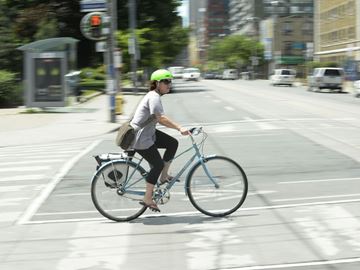
Toronto slowly improving its bicycle network
New downtown lanes a game-changer, says bicycle advocate Yvonne Bambrick
City bike plan
Staff/Metroland
York Guardian
In 1991, 15-year-old Yvonne Bambrick rode the streets of Toronto with the brash confidence – making the considerable daily commute from her family home at Victoria Park in East York to Jarvis Collegiate by bicycle, along busy downtown streets that made scant accommodation for bikes.
“Back when I was a naive teenager, I didn’t think twice about it,” recalls Bambrick 25 years later, sitting on a sunny patio in Kensington Market, steps from one of the city’s massive on-street bike racks and just over a block from the busy College Street bike lanes.
“The concept of bike lanes wasn’t on my brain at all. I did know it wasn’t safe – I got doored on the Danforth and had a wipeout on bad road conditions. Otherwise I was just a teenager on her bicycle, happy to be free getting where she’s going. It meant I could have all the ice cream I wanted.”
In 2016, the Toronto that Bambrick bikes around is a much safer place. Toronto has a total of 558.4 kilometres of on-street bike lanes, including white bicycle lanes, contra-flow lanes that run against the flow of traffic, so-called “sharrows”, signed routes without pavement markings, and even a few kilometres of cycle tracks that are fully separated from traffic.
A lot of people use those lanes. According to the 2006 Census, Torontonians bike to and from work like nobody else in the Greater Toronto and Hamilton Area, with 19,780 commuting by bike compared to 14,925 in 2001.
In 2015, Bambrick published a book for those cyclists: The Urban Cycling Survival Guide: Need To Know Skills and Strategies for Biking in the City. It was a book culled from her work advocating for cyclists as the head of the Toronto Cyclist’s Union – now Cycle Toronto – and her years riding Toronto’s sometimes tricky streets.
There’s a lot to know: how to make a safe left turn (there’s more than one way); how to suit up for cycling in bad weather; dealing with potentially hostile interactions; and how to navigate all those different styles of bike road infrastructure.
Currently, most of those routes are in neighbourhoods surrounding the downtown core – including the relatively new cycle tracks on Sherbourne, Adelaide and Richmond streets.
“Richmond-Adelaide were a game changer,” says Bambrick. “I was having to ride there all the time (before), and I’m a confident rider but even for me it was tough. This is amazing. Transformative.”
Bambrick and other cycling advocates are hoping for more change like that, on roads that extend beyond the downtown. This summer, the city will be embarking on a pilot project to try a cycle track along Bloor Street through the Annex neighbourhood – a test, to see whether a city-spanning track could be installed the length of Bloor Street and Danforth Avenue.
And the outcome of that could determine the implementation of parts of the city’s next big plan for cycling expansion: the Cycling Network 10 Year Plan. Under that plan, Toronto’s bikeway and bike trail network would be extended to the ends of the city: north along Yonge Street to Steeles Avenue; on Kingston Road in Scarborough from Eglinton Avenue to the Highland Creek Trail; Kipling Avenue from Bloor Street to the Waterfront Trail; and Midland Avenue, from Steeles to Lawrence avenues.
Toronto’s Chief Planner Jennifer Keesmaat said to provide an effective cycling alternative, the network needs to expand in the same way that transit networks expand – in a continuum. Do that, she says, and it becomes viable to commute, at least to downtown, from nearly anywhere in the city.
“With cycling, distance isn’t that much of a problem,” says Keesmaat. “The city is really not that big, and 10 kilometres, 20 kilometres isn’t really a big deal. And from the centre of the city you can get pretty much anywhere on a 10 kilometer bikeway. If you’re cycling from Scarborough to Etobicoke, that’s a big trip. But from the centre of the city you can get anywhere – all you need is safe infrastructure.”
The other thing that a cyclist needs, of course, is the will, and a bit of know how. Bambrick is an evangelist for the former and a resource for the latter. When asked what it takes to get on a bike, after dutifully recommending a careful read of her book, she suggests a step-by-step approach. Borrow a bike-share bike; go riding with a friend on a quiet street. If it’s been awhile, take a BikeShare course.
And remember: roads were originally for bikes.
”We paved our roads because wheelmen’s clubs advocated to get the roads paved. The bicycling movement has been around for a long time,” says Bambrick. “It’s never gone away.”
Friday, July 8, 2016
Ontario Trails News - trails news from all over Ontario, about Ontario trails and Ontario Trails Activities
|
Add Your Training Trail! |
The U-18 Baseball World Cup in 2017 in Thunder Bay and 15 city athletes are eligible for sport funds
By Cathy Alex, CBC News Posted: Jun 30, 2016 6:30 AM ET Last Updated: Jun 30, 2016 6:30 AM ET

Tobias Quinn of Thunder Bay, competing in the freestyle 1.3km event at the 2016 Haywood NorAm World Junior/U23 Trials and Ontario Cup at the Lappe Nordic Centre is a biathlete and part of Ontario's Quest for Gold program. (Martin Kaiser)
The Ontario government is investing $16.76-million in sports in the province, and some of that money could be coming to athletes, and event organizers in northwestern Ontario.
"Sport is all about creating opportunity for young people to participate," says Eleanor McMahon, Minister of Tourism, Culture and Sport.
"It's about creating healthy habits for life. It's about getting young people excited and energized."

Eleanor McMahon, the Minister of Tourism, Culture and Sport in Ontario, says the provincial government is investing $16.76-million in athletes and sporting events across the province. (Twitter)
There are 15 athletes in Thunder Bay, participating in diving, curling, cross-country-skiing and wrestling, who are eligible for funding from Ontario's Quest for Gold program, she said.
"It pays for their expenses, generally, it helps them to excel, and it helps them to spend time on their sport," McMahon said.
Organizers of theUnder-18 Baseball World Cup in Thunder Bay in 2017 may also be able to access funding for the event through the Ontario Sport Hosting Program.
"I think that would be absolutely fantastic," said McMahon.
"My understanding is that there has been an approach made to the ministry," she said, "and so I look forward to hearing more about that and to providing assistance in any way we can" including assistance with the application process.
A portion of the funds from this program are also earmarked for helping Indigenous and low-income children and families have more access to sports, said McMahon.
The Community Aboriginal Recreation Activator program provides funding to neighbourhood groups and First Nations to hire people to create a sports and activity program, designed specifically for the needs of that community, she said.
Thursday, July 7, 2016
Ontario Trails News - news from around Ontario, about Ontario Trails and Ontario Trails Activity
|
Add Your Event |
ATV's on walking trails
Pedestrian concerns over motorized vehicles on Timmins walking trails. Jessica Gosselin reports.
http://northernontario.ctvnews.ca/video?clipId=902896
|
Wednesday, July 6, 2016
Ontario Trails News - an archive of significant Ontario trails News and Events taking place in Ontario, cycling in Ottawa
|
Add Your Trail |
Denley: Let's not overstate the virtues of cycling
 RANDALL DENLEY
More from Randall Denley
Published on: June 29, 2016 | Last Updated: June 30, 2016 9:30 AM EDT

Cyclists and drivers should all obey traffic rules. ERROL MCGIHON / .
I’ve never really understood just what it is that makes riding a bicycle so special. Sure, riding a bike is good exercise and an inexpensive way to get around, but that’s all it is. Cycling’s contribution to our transportation needs is minimal, as is its contribution to improving the environment.
And yet, when they climb on a bike, some cyclists believe they are on a planet-saving moral journey that entitles them to demand special bike lanes and as much government spending as they can get. In addition, they claim a right to ride on sidewalks as required and to ignore the laws that apply to bicycles. All while complaining about drivers and claiming that cyclists are subsidizing motorists.
The city government encourages this line of thinking by pretending that cycling is a vital part of our transportation network, at least until it comes time to spend money on it. According to the city’s transportation master plan, cycling makes up about 2.7 per cent of the morning commute and two per cent over the whole day. As a means of practical transportation, it is close to irrelevant.
RELATED
Reevely: The biking myths that won't die
Reevely: Ottawa's bike-friendliness is a lie
Therien: Cyclists, wear a darn helmet!
Bylaw blitz seeks to bust cars in bus and bike lanes
You’d never know it from watching Ottawa’s cyclists, but a bicycle is classified as a vehicle under the Ontario Highway Traffic Act. That means cyclists must obey all traffic laws and have the same rights and responsibilities as drivers, but who hasn’t seen cyclists drive up on sidewalks, sail through stop signs, ride the wrong way on one-way streets and make unsignalled turns?
My colleague David Reevely has written a pair of columns this week that offer some insight into cyclists’ thinking. Without endorsing the practice, he explains that cyclists make a habit of gliding through stop signs because bike routes off major roads are often on streets with stop signs every 50 feet. Actually stopping would take away all of a cyclist’s momentum. Similarly, cyclists ride on sidewalks because the city has refused to make major roads like Bank Street safe.
Clearly, these things happen, but who really thinks it’s safe to ride a bike on a sidewalk meant for pedestrians? One can easily imagine the sympathy a driver would get if he rolled through a series of stop signs, citing reluctance to wear out his brakes, or a desire to burn less fuel.
The city has responded to cyclists’ dissatisfaction by building bike lanes as an attempt to help cyclists get safely through the core. As Reevely observes, bicycle lanes like those on Laurier Avenue are clearly hazardous. The problem comes when vehicles turn off Laurier and potentially cut off or even run over cyclists. This is drivers’ fault, mostly, but cyclists are responsible for their own safety. Anticipating hazards when riding in urban traffic would seem to be a basic survival skill. A bicycle lane isn’t an autobahn for cyclists.
Of all the claims that are made about cycling, the idea that cyclists are subsidizing motorists is the most dubious. Cyclists use the roads, just like car drivers do. Unlike car drivers, they don’t pay licence fees and gas taxes to contribute to their upkeep. Everyone benefits from roads. Without them, we wouldn’t be able to get groceries to the store or a repair person to the house. Even the virtuous electric cars would be rendered useless. We wouldn’t want that.
Cyclists would get a lot more respect if they were willing to follow the rules of the road. This is not just because drivers like rules. It’s a safety issue. Unpredictable moves lead to accidents. Despite what some cyclists seem to think, drivers actually do not want to run them over.
The recent dustup between drivers and cyclists suggests they have nothing in common, but the thing that should unite them is the poor condition of our roads. Too many of our major streets are tough to drive on in a car, much less a bike. Fixing those roads, not more bike lanes, would be the best thing the city could do for cyclists and drivers.
Randall Denley is an Ottawa commentator, novelist and former Ontario PC candidate. Contact him at randalldenley1@gmail.com.
Tuesday, July 5, 2016
Ontario Trails News - a roundup of Ontario Trails News, a personal walk for Parkinsons from People Magazine
|
|

Monday, July 4, 2016
Ontario Trails News - an information archive ab out Ontario Trails and Ontario trail activity, development and projects!
|
Add your Event |
Maintenance Begins Along the Cataraqui Trail

Various sections of the Cataraqui Trail will be undergoing regular maintenance over the next few weeks. Part of this maintenance will also include the installation of new gates at several locations. At this time no closures will take place but the public is advised to exercise caution in these areas and to observe directions from the workers involved.
The Cataraqui Trail is a 104 km long multi-use trail along a former railway line that goes from Smiths Falls to Strathcona (near Napanee). Permitted uses on the Trail include hiking, cycling, skiing and horseback riding.
Gates along the Cataraqui Trail are open during snowmobile season to allow snowmobilers with a valid permit to use the Trail. They are closed during the balance of the year to keep other motorized vehicles off the Cataraqui Trail. Other than snowmobiles, only authorized maintenance vehicles are allowed to have access to the trail.
For more information about the Cataraqui Trail please visit CataraquiTrail.ca
Thursday, June 30, 2016
Ontario Trails News - an ongoing archive of Ontario Trails activity, recreational events and trail development
|
Add your event |
Sold out event draws 220 riders for Manitoulin Passage Ride 2016
By Alicia McCutcheon -
Jun 8, 2016
 The family that Passage Rides together... Passage Ride 2016 was a great family event.
MANITOULIN—The annual Manitoulin Passage Ride has once again been hailed as a major success for the Manitoulin Island Cycling Advocates (MICA), who host the event, and for the economy of Manitoulin as a whole.
It was a sold out ride of 220 registered riders, 140 of whom sailed to Manitoulin via the Chi-Cheemaun ferry. MICA President Maja Mielonen noted that of the cyclists who did not sail to the Island, most came from across Northern Ontario, including Sudbury, Sault Ste. Marie and North Bay. Manitoulin roads are a popular cycling destination, especially along the paved shoulders of Highway 6.
The Central Manitoulin Lions Club hosted a dinner and dance for the cycling guests on Saturday night with 240 people in attendance for the meal (with food by Garden’s Gate and the Burt Farm) with entertainment by Amanda Davids and the FunkRiders. Farquhar’s chocolate milk for the weekend was also provided by the Manitoulin West Sudbury Dairy Producers.
This year, there were three support stations located at Kenjgewin Teg in M’Chigeeng, LocoBeanz in Manitowaning and Northwind Adventures in Kagawong. On Saturday, sponsored by Kenj and 4elements, presentations by Justin Tilson on sustainable transportation and Pat McGibbon on fixing bike tires added to the scenic rides around Manitoulin. Ms. McGibbon also doubled as this year’s bike medic.
Many of the cyclists also toured the newly opened Muchmor Gallery in Providence Bay “and were just floored by how beautiful it was,” Ms. Mielonen said.
On Day 2 in Tehkummah, the Triangle Club put on a spread for the Passage Ride lunch complete with music by The Islanders. Ms. Mielonen said the cyclists were blown away by the “authenticity” of the Tehkummah event.
She also gave a nod to Ontario Provincial Police Community Services Office Steve Hart for his help with ensuring a safe ride for everyone and helping when necessary.
“There are more and more big groups that are coming,” the MICA president said, noting that about 50 riders came a day earlier and others didn’t depart until Monday, thanks to a partnership with the Chi-Cheemaun that gives cyclists free passage from the Friday to Monday. The Passage Ride expressed its gratitude to the Chi-Cheemaun by making the new Chi-Cheemaun brand feather wake logo the front of the 2016 jersey.
Ms. Mielonen also took the opportunity on Saturday night to announce the launch of the Alvar Treasure Rides all-inclusive cycling package coming this September. The package includes five days of cycling and four nights including ferry passage, four breakfasts, five lunches and four suppers, luggage shuttle, a cycling route map and museum fees for $980/person plus tax for double occupancy or $1,200/person plus tax for single occupancy.
Algoma-Manitoulin MP Michael Mantha was also on hand for the Saturday evening dinner and spoke to the cyclists on MICA’s good works with getting Island shoulders paved and its current battle to see Highway 540 among them. (Everyone signed MICA’s current petition to the Ontario government.) Mr. Mantha is the co-chair of the All-Stripe Cycling Caucus in the Ontario legislature and has worked with Ms. Mielonen and the rest of MICA on all of her lobbying efforts. Algoma-Manitoulin MPP Mike Mantha joins Maja Meilonen and Guy Nielon in celebrating the success of this year’s passage ride.
“We’re fighting like heck for Highway 540,” she said. “Since (the paving of the shoulders) of Highway 6, a lot has happened. Everyone wants in on the paved shoulders and there’s more government focus.”
Ms. Mielonen hinted that there could be more lobbying in MICA’s future too, this time to lobby municipalities to pave their shoulders.
Ms. Mielonen praised the numerous businesses that helped make the Passage Ride a success.
“It’s all coming together.”


Wednesday, June 29, 2016
Ontario Trail News- what others are posting about Bill 100, The Supporting Ontario Trails Act - a first for trails in Ontario.
|
Add Your Trail! |
Ontario government clears the way for strengthening province’s trail systems with the passing of Ontario Trails Act, 2016



Canada June 7 2016
The province of Ontario is home to over 2,500 individual trails, stretching over 80,000 kilometres. The popularity of trails in Ontario has been steadily increasing over the last number of years, and this trend is expected to continue. In addition to contributing to the physical and mental health of Ontarians, these trails also contribute substantially to the province’s economic health.
In 2014, hiking expenditures generated about $559 million toward Ontario’s Gross Domestic Product (GDP), and the Ministry of Tourism, Culture and Sport estimates 18,000 jobs to be directly connected to the industry.1
A recently passed piece of legislation, the Ontario Trails Act, 2016 (the “Act”), aims to strengthen Ontario’s network of trails by introducing new measures to protect land owners, clarify liability, and cultivate trail tourism. The significant highlights of the Act are as follows:
- Clarifying circumstances in which the lower liability standard set out in section 4(3) of theOccupiers’ Liability Act will apply;
- Increased penalties for damage to Crown land under the Public Lands Act;
- Increased maximum fines for trespassing under the Trespass to Property Act;
- Allowing for voluntary formalization of easements between land owners and land users; and,
- A number of softer measures including a proposed trail classification system, new recognition mechanisms for “trails of distinction”, and the proclamation of “Trails Week”, beginning the first week in June.
Currently, subsection 4 (3) of the Occupiers’ Liability Act sets out circumstances in which a person who enters on certain premises is deemed to have willingly assumed all risks, and in which a modified standard of care applies (requiring the landowner not to intentionally injure, or to act with reckless disregard of the safety of persons entering onto his or her property). One of those circumstances turns on whether a fee is paid by the user. The Act provides for a new subsection 4 (3.1), which provides, for greater certainty, that a fee charged for a purpose incidental to the entry or activity, such as for parking, or the receipt by a non-profit recreation club or association of a benefit or payment from or under the authority of a government or government agency, will not prevent application of the modified standard of care. In addition, the Act expands the list of premises to which the modified standard of care applies to include portage routes.
A key component of Ontario’s trail system is the need for cooperation between land owners and trail users. The government is optimistic that land owners will be more likely to permit the use of their property for trails, encouraged by the introduction of voluntary property easements. Unfortunately, however, some landowners are under the mistaken impression that the Act could automatically convert existing land use agreements into an easement registered on title. Critics worry that this may cause landowners to pre-emptively shut their gates and renege on existing “handshake agreements” that allow for use of their property.
Only time will tell if this new legislation will help expand Ontario’s trails network, or serve to fracture existing, informal relationships between property owners and land users. The 80,000 kilometres that currently span Ontario’s urban, suburban, and rural spaces has developed somewhat organically, without formalized property easements. New rules will change these relationships. Some worry that the Act may be seeking to fix a problem which doesn’t exist. However, the expansion of circumstances in which the modified standard of care under the Occupier’s Liability Act will apply, and increased fines for breach of property rights should give landowners some comfort, and it is hoped, encourage participation in trail systems.
Tuesday, June 28, 2016
Ontario Trails News - G2G Trail, cycling information, paddling and Add Your Event and lots more news daily from OntarioTrails!
|
ADD YOUR EVENT |
 |
VIEW FULL ARTICLE |
 |
VIEW FULL ARTICLE
You talked! We listened! As a Canadian campaign we want you to feel secure about donating in Canadian dollar currency instead of US currency. Visit our new campaign donation page at https://www.tilt.com/tilts/
Each trail segment and community can benefit directly from this $60,000 fundraising campaign. We’ve had a tremendous amount of support in the past from communities that are touched by the G2G Rail Trail experience. The 127 km route is made up of the amazing Kissing Bridge Trailway, Perth Harvest Pathway and the Lake Huron Route.
G2G Crowdfunding Campaign Info:
The Guelph to Goderich Rail Trail surrounds cyclists and hikers with the richness of Ontario’s pastoral landscape and rural heritage. Through hushed forest groves and rolling Mennonite farmland, across river valleys and wetlands, past 13 villages and towns, to the sunset horizon of one of the world’s Great Lakes, visitors of all fitness and skill levels can enjoy any part of the G2G’s 127-km length through four counties. Completion of the G2G Rail Trail opens Ontario’s pastoral heartland to the global fitness and recreation phenomena of backpacking and cycle tourism. The G2G helps rural Ontarians share their countryside and hospitality with the world.
More information on the G2G Rail Trail can be found at: http://www.g2grailtrail.com/ or www.facebook.com/G2GRailTrail
Facebook sharing post:
Share the video WITH the link (https://www.tilt.com/tilts/
A charitable donation tax receipt will be issued for all people donating $20 or more.
|
Subscribe to:
Posts (Atom)